Q1. What are focus and epicentre of an earthquake?
Solution
The place inside the earth's crust where the earthquake is generated, is called focus of the earthquake. The point on the earth's surface directly above the focus is called epicentre.
Q2. What magnitudes of earthquakes on Richter scale are considered destructive?
Solution
The magnitude of earthquakes higher than 7 on Richter scale are considered destructive.
Q3. What happens when we touch the metal cap of a charged electroscope with our finger? What is this process known as?
Solution
The leaves of an electroscope collapse as soon as we touch the metal cap with hand because the leaves of the charged electroscope lose charge to the earth through our body. This process is known as EARTHING.
Q4. What are the waves produced by tremors on the surface of the earth called? Which instrument is used to record them?
Solution
Seismic waves are the waves produced by tremors on the surface of the earth. The seismograph is an instrument used to record them.
Q5. An electroscope is a device that is used to
Solution
An electroscope is a device that is used to detect whether an object is charged or not.
Q6. If the divergence of the leaves of an electroscope is more, then the given body is positively charged because
Solution
If the divergence of the leaves of the electroscope is more, then the given body is positively charged because the charge on the leaves is more on touching the positively charged body.
Q7. The Earth's mantle lies between
Solution
The mantle is the thick layer of hot, solid rock between the crust and the outer core.
Q8. Does a charged object get uncharged on touching with hand? Explain.
What is this phenomenon called?
Solution
Yes. This is because human body is a conductor of electricity. So, when we touch a charged object, our body conducts its charges to the earth. That is why a charged object loses its charge, if we touch it with our hand.
This phenomenon is known as electric discharge.
Q9. What are seismic waves? Name the instrument which records these waves.
Solution
Tremors or vibrations caused by the earthquakes which travel in the form of waves within the earth or along the earth's surface, are called seismic waves. Seismograph is an instrument which records these waves.
Q10. Lightning contains a tremendous amount of
Solution
Lightning contains a tremendous amount of electrical energy. It is actually a great electric spark in the sky.
Q11. Suppose you are outside your home and an earthquake strikes. What precautions would you take to protect yourself?
Solution
The following precautions should be taken :-
1. Find a clear spot, away from buildings, trees, poles and electric poles, signboards and overhead power lines and drop to the ground.
2. Do not use elevators.
3. If you are in a car or a bus, do not come out and drive slowly to a clear spot. Stay inside a car till the tremors stop.
Q12. In order to protect against electrical shocks, _________is done in domestic circuits. It is a process of charge transfer from the metal case of an electrical appliance to the ground. This transfer of charges involves ____________.
Solution
In order to protect against electrical shocks, earthing is done in domestic circuits. It is a process of charge transfer from the metal case of an electrical appliance to the ground. This transfer of charges involves conduction.
Q13. How would you use an electroscope to find out whether an object is charged or not?
Solution
Touch the body to be tested with the metal disc of an electroscope. If the leaves of an electroscope open up (diverge), the body is charged. If the leaves remain unaffected then the body has no charge.
Q14. What are fault zones?
Solution
Since earthquakes are caused by the movements of the plates, the boundaries of the plates are the weak zones where earthquakes are most likely to occur. Such areas are called seismic or fault zones.
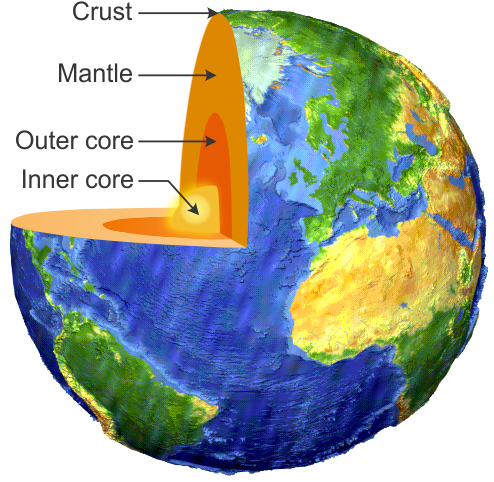
Q15. Draw an internal structure of earth.
Solution
Internal structure of the Earth:
Q16. Which of the following cannot be charged by friction, if held by hand? (a) a plastic scale (b) a copper rod (c) an inflated balloon (d) a woolen cloth. Why?
Solution
Copper rod
Except copper, the other three are insulators whereas copper is a conducting object. As soon as it gets charged by rubbing with another material, the electric charge produced on its surface flow through our hand and body into the earth and it remains uncharged.
Q17. What is earthing? Why it is done?
Solution
The process of transferring of charge from a charged object to the earth is called earthing. It is provided in buildings to protect us from electrical shocks due to any leakage of electrical current.
Q18. What is the cause of lightning?
Solution
Lightning is caused by the accumulation of charges in the clouds.
Comments
Post a Comment