Q1. The process by which the test tube babies are developed is called:
Solution
The process by which the test tube babies are developed is called in vitro fertilisation in which the zygote is allowed to develop for about a week and then it is placed in the mother's uterus.
Q2. Name the male reproductive organs.
Solution
The male reproductive organs include a pair of testes, two sperm ducts and penis.
Q3. What is internal fertilization? Name any two animals in which this fertilization occurs.
Solution
Fertilization which takes place inside the female body is called internal fertilization. Internal fertilization occurs in animals such as humans, cows, dogs and hens. (Any 2)
Q4. (i) Draw a labelled diagram of female reproductive system.
(ii) What is the function of fallopian tube?
Solution
(i) Human female reproductive system:
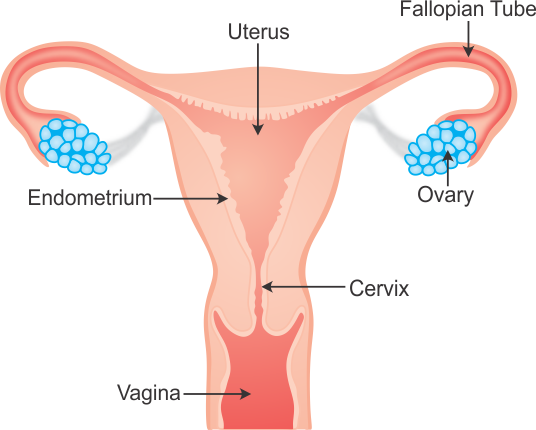 (ii) Function of the fallopian tube: Fallopian tube is the site of fertilsation, the sperm fuses with the ovum. It also passes the fertilised ovum or the zygote towards the uterus by its ciliary action.
(ii) Function of the fallopian tube: Fallopian tube is the site of fertilsation, the sperm fuses with the ovum. It also passes the fertilised ovum or the zygote towards the uterus by its ciliary action.
Q5. Discuss the development of chick from zygote.
Solution
Soon after internal fertilization in hen, the zygote divides repeatedly and travels down the oviduct. As it travels down, many protective layers are formed around it. The hard shell in a hen's egg is one such protective layer. After the hard shell is formed around the developing embryo, the hen finally lays the egg. The embryo takes about three weeks to develop into a chick. After the chick is completely developed it bursts open the egg shell.
Q6. Write a short note on human sperm.
Solution
Sperm is the male gamete produced by testes. It is a single cell with all the usual cell components. It is very small in size. Each sperm has a head, a middle piece and a tail.
Q7. Briefly describe the human male reproductive system.
Solution
The male reproductive system consists of the following parts:
(i) Testes: It occurs in pair and are somewhat oval in shape. Testes lie in the sac like structure called scrotum and produce sperms.
(ii) Vas deferens: It is also called sperm duct. This duct starts from the testis and joins the urethra. It carries the sperms to the urethra.
(iii) Urethra: Vas deferens carrying the sperms receives the fluid secreted by the seminal vesicles. This fluid provides nourishment to the sperms.
(iv) Penis: Urethra leads to a muscular organ called penis. It is used to pass urine and deliver sperms into the vagina of the female body.
Q8. Diagrammatically show the process of fertilisation.
Solution

Q9. What is the function of:
i) Testes
ii) Sperm duct / vas deferens
iii) Ovary
Solution
i) Testes produce the male gametes called sperms.
ii) Sperm duct / vas deferens carries the sperms from testes to the penis.
iii) Ovary produces the female gamete called an ova.
Q10. (a) Differentiate between oviparous and viviparous animals.(b) Write the steps in the lifecycle of silkworm.
Solution
(a)
Oviparous animals
Viviparous animals
The animals which lay eggs are called oviparous animals.
The animals which give birth to young ones are called viviparous animals.
Example - Hen, frog, fish
Example - Humans, dog, cow
(b) Egg  Larva / Caterpillar Pupa Adult
Larva / Caterpillar Pupa Adult
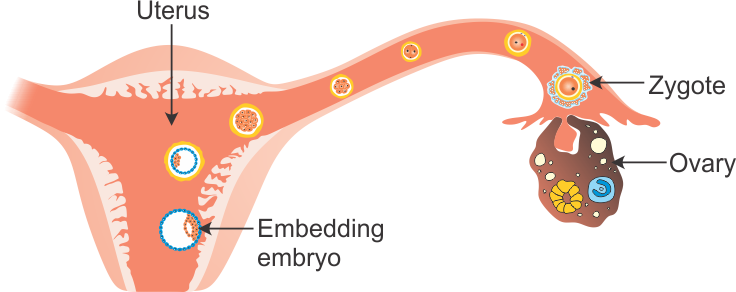
Q11. What do the below figures represent?
(a)
 (b)
(b)
(b)Solution
(a) Zygote formation and development of an embryo from the zygote.(b) Embedding of the embryo in the uterus i.e. implantation
Comments
Post a Comment